India s Electronics Manufacturing Surge Redefines Global Supply Chains
India has experienced rapid growth in its manufacturing sector over the last few years
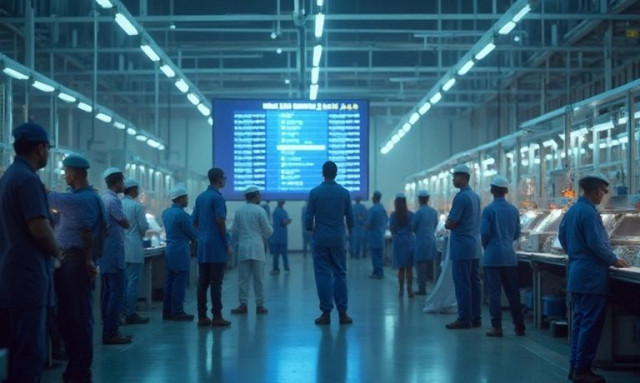
Building on its favourable demographic dividend, favourable government
political and policy environment, and rising global desirability as an R&D and
production destination, along with a changing geopolitical climate, India has
experienced rapid growth in its manufacturing sector over the last few years.
With extraordinary expansion in its manufacturing landscape, many experts have
referred to the present scenario as the golden era of India’s manufacturing.
First, the policy environment, focusing on Made in India, accompanied by
Production-linked incentives, has helped in developing its electronics industry,
which presently attracts big investments, while providing impetus to local
production. Launching itself as the global hub for electronics manufacturing,
India’s electronics production is likely to reach USD 300 billion by next year.
India has emerged as the second-largest mobile phone producer in the world.
Moreover, experts predict that India’s share in global iPhone manufacturing will
at least double in 2025, from 14-15% currently. One major reason behind this
expected growth would be the manufacturing shift of Apple Inc. to India from
China to diversify its supply chain. The shift is an obvious result of the growing
geopolitical tensions between China and the US, and the resulting tariff tiffs.
India's electronics production has almost doubled from US$ 48 billion in 2017 to
US$ 101 billion in 2023, driven mainly by mobile phones (accounting for 43%
of production value). Besides, under the Semicon India Program, Indian has
made rapid advancements in the development of a sustainable semiconductor and
display ecosystem. By the end of 2025, India’s first indigenous semiconductor.
Moreover, rising labour costs in China, apart from geopolitical issues, provide India and its demographic dividend a fertile chance to welcome the shift in global manufacturing hub to New Delhi.
Second, at the global stage, India has galloped up its foreign technical
collaborations with the US, Germany, and Japan for mobile phones, electronics,
and food processing.
For instance, Tata Electronics Private Limited (TEPL) is
partnering with PSMC (Taiwan) to establish a semiconductor fab facility, and CG
Power and Industrial Solutions Limited will be setting up an OSAT facility in
India with an investment of Rs. 7,584 Crore, with a joint venture partnership
with Renesas Electronics America Inc., USA, and STARS Microelectronic,
Thailand.
Moreover, with the strengthening of relations between New Delhi and
the Global South, India has already emerged as a major trading partner with the
Global South for pharmaceuticals and telecommunication equipment.
Thirdly, and circling back to the issue of searching for alternatives to China, India
shines as a very palatable case for various reasons. Its large, technologically
educated workforce, with cost-effectiveness in terms of cheaper labour, and its
non-controversial and non-confrontational (and very amicable) geopolitical and
diplomatic relations with the rest of the world (except its close neighbour), India
is a crucial China plus one alternative. In technology manufacturing, many
international companies look towards India as a fertile ground due to its
favourable policies, booming consumer market, and the nation’s remarkable.
Over the past few years, “India’s manufacturing sector has
witnessed major new investments in production facilities by leading multinational
corporations like Siemens, GE, Philips, Samsung Electronics, PepsiCo, ABB,
Micron, etc.”, making it a rising China plus one hub.
With these advantages and improving relations with the Global South, India
provides an avenue for changing the trade order, which relies on “Team China”
as the crucial provider of electronics. Given the expanse of Chinese presence and
(possibly not so benevolent) influence of China in the Global South, there are
rising international political economy concerns. This becomes highly important
with changing times when scholars are raising concerns over China’s growing
digital expansion in the Global South, with a looming narrative about Chinese
digital authoritarianism and “China’s growing digital presence for digital
governance at both global and national levels”.
Studies suggest, despite China’s seemingly beneficial Digital Silk Road’s presence in North African countries, no opportunities for knowledge transfers and technology upgradation have been created. Any major diffusion of Chinese digital technologies “has mainly served to reconfigure local digital ecosystems toward a domination of
Chinese products, processes, and systems.
As put forth by Harvard’s Prof. Ricardo Hausmann, India has massive potential
to goods supplier to the Global South, which is also evident from the growing
establishment of Global Capability Centres (GCC) across India and encouraging
projections that the electronics industry will grow to US$ 300 billion by 2026.
Thus, India not only plays a central role in China plus one strategy of the countries
across the globe, it also possesses immense potential to establish itself as a global
leader in electronics manufacturing. Capitalizing emerging opportunities and
geopolitical developments along with its inherent economies of scale advantages,
and value chain integration, India is expected to transform its electronics sector
and become a hub for the rest of the world, especially for the Global South.