Pakistan’s Support for Terrorism Ensues: One Year After Pahalgam Attack
Twelve months on, the question is no longer whether Pakistan hosts the machinery of transnational terrorism
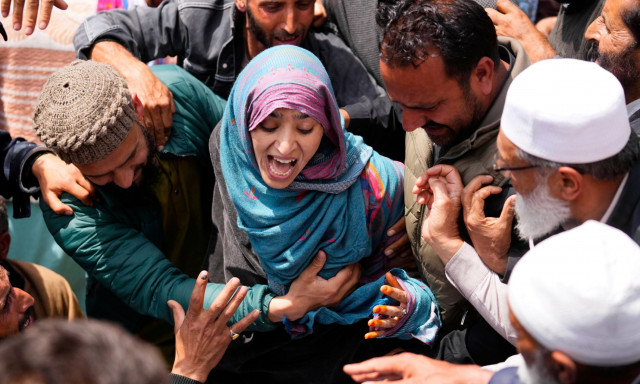
One year ago, on 22 April, four armed men emerged from the pine forests flanking the Baisaran meadow near Pahalgam and, after instructing the tourists before them to recite the kalma, proceeded to execute 26 Hindu tourists. The choreography of the killings, the equipment recovered from the scene, the identity of the handlers traced to Pakistan-occupied Kashmir, and the claim of responsibility twice issued on Telegram by The Resistance Front (TRF), together formed a familiar signature. What Pahalgam revealed was not a lapse in some moribund terror ecosystem but the continued industrial capacity of a state-sponsored franchise operating from Pakistani soil.
Twelve months on, the question is no longer whether Pakistan hosts the machinery of transnational terrorism. The documentary record, the indictments in US courts, the arrests of Pakistanis on Korean soil, and the formal designations issued by Washington itself settle that argument. The real question is why the terror infrastructure continues to expand despite operational setbacks, diplomatic exposure, and the kinetic response delivered by India through Operation Sindoor in early May 2025.
TRF was established in 2019 as a proxy of Pakistani-based Lashkar-e-Taiba (LeT) to conduct attacks in Jammu and Kashmir. On 17 July 2025, the US Department of State formally listed TRF as a ‘Foreign Terrorist Organisation’ and Specially Designated Global Terrorist entity, describing it explicitly as an LeT “front and proxy” responsible for the deadliest civilian attack on Indian soil since 26/11. The designation was not a diplomatic courtesy. It aligned US sanctions instruments with the operational reality that Indian intelligence had documented for more than half a decade.
Rather than forcing a retreat, the designation has coincided with a more assertive mainstreaming of Pakistan’s jihadist network. On 8 October 2025, at the Markaz Usman-o-Ali compound in Bahawalpur, Jaish-e-Mohammad (JeM) announced the formation of its first women’s wing, “Jamaat-ul-Mominat”, under Sadia Azhar, sister of Masood Azhar and widow of Yusuf Azhar (killed at Markaz Subhanallah during Operation Sindoor). Within weeks, over 5,000 women had reportedly been enrolled through a 40-minute online curriculum titled Daura-e-Taskiya, with plans for district-level units across Pakistan-occupied Kashmir.
LeT has moved in parallel. A 135-member maritime unit, styled the “Water Force,” now trains at dispersed sites across Islamabad, Muridke, Lahore, Bahawalpur, Karachi, Kasur, Alipur, the Suran River in Poonch, Mangla Dam and Muzaffarabad. Senior commanders have been filmed personally supervising scuba, underwater manoeuvre and high-speed boat drills modelled on the 26/11 Mumbai attacks template. The political front of LeT, the Pakistan Markazi Muslim League (PMML), held its Takbeer Conference in Lahore on 28 May 2025 under hoardings alongside Chief of Army Staff Field Marshal Asim Munir with designated terrorist Saifullah Kasuri. Rallies through 2025 and into 2026, including those led by Hafiz Talha Saeed, have proceeded under visible police protection.
Following Operation Sindoor, JeM launched an online campaign to raise roughly PKR 3.91 billion to build 313 mosques, copying LeT’s dispersed markaz model. The collection routes through Easypaisa, Sadapay and JazzCash accounts held by members of Masood Azhar’s family, including his brother Talha al-Saif. Beneath this operational shift lies a structural one. Investigators tracking LeT and JeM flows during the 2025 crisis observed a shift from bank accounts and bulk cash to fragmented micro-donations via digital wallets and, increasingly, to Tether (USDT) and Bitcoin transfers executed on peer-to-peer exchanges. Pakistan’s creation of the Pakistan Crypto Council in March 2025, followed by an agreement with World Liberty Financial, has added a further layer of deniability.
The consequences are now documented well beyond South Asia. The Global Terrorism Index 2026 ranks Pakistan as the world’s most terrorism-affected country for the first time, with a score of 8.574 and 1,139 terrorism-related fatalities recorded in 2025. The Congressional Research Service brief updated on 25 March by K. Alan Kronstadt identifies Pakistan as both a base and a target for at least fifteen active terrorist outfits, twelve of them US-designated FTOs, almost all of which have survived every cycle of Pakistani counter-terrorism policy since the 2014 National Action Plan. Their transnational reach is a reality now and can have serious consequences for world peace.
On 6 March, a federal jury in Brooklyn convicted forty-seven-year-old Asif Merchant, a Pakistani national, of terrorism and murder-for-hire charges linked to an IRGC-directed plot to assassinate senior US political figures during the 2024 campaign. The Iranian direction does not cover the Pakistani terror connection that recruited and prepared him. It underscores connections of that infrastructure across clients. On 8 April, Muhammad Shahzeb Khan, a twenty-one-year-old Pakistani citizen, pleaded guilty before a federal court in Manhattan to an ISIS-inspired plan to conduct a mass shooting at a prominent Jewish centre in Brooklyn, timed to the first anniversary of the 7 October 2023 Hamas terror attack. Eight months earlier, on 2 August 2025, South Korean police arrested a Pakistani national working as a market clerk in Seoul’s Itaewon district. He had been formally inducted into LeT in 2020 following weapons and infiltration training, marking the first detention of a UN-designated terrorist organisation member on Korean soil.
Taken together, these data points expose the Pakistani state’s fake narrative that it is a victim of terrorism rather than its incubator. Pakistan is simultaneously both, and the two conditions sustain one another. The terror proxies cultivated for strategic depth against India do not remain confined to just one territory. They recruit women in Bahawalpur, train divers at Mangla Dam, route funds through mobile wallets in Karachi, surface as shopkeepers in Itaewon, and emerge as defendants in Brooklyn. One year after Pahalgam, the policy question for Western capitals is not whether Pakistan can be pressured to dismantle the terror networks it has built. It is whether the FATF, the UN 1267 Sanctions Committee, and bilateral partners are prepared to impose costs on it in light of the documented reality. Anything less will vindicate what Pahalgam’s victims already imply: that the terror franchise of Pakistan, supported by its military, is profitable, the clientele is diversified, and the signal from the international system is that terror remains an export that pays. The international community should continue to pressure Pakistan military to stop spreading terrorism.