Islamabad’s Terror Label on Azad Kashmir’s Protest Movement
The eruption of violence in Poonch and Rawalakot is the culmination of years of accumulated grievances, institutional marginalisation, and the state’s refusal to engage meaningfully with local demands
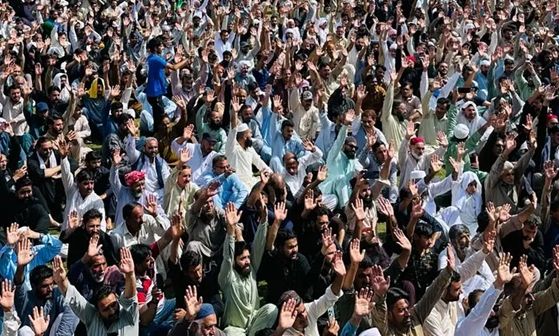
This past week’s deadly unrest in Pakistan‑administered Jammu and Kashmir (PaJK) has already claimed the lives of at least 35 people, underscoring the fragility of Islamabad’s governance in Azad Jammu and Kashmir (AJK) and Gilgit‑Baltistan (GB). These strategically located territories, long treated as instruments of Pakistan’s ideologically motivated revisionist policy, have been subjected to a regime of curtailed rights, discretionary financing, and coercive control. The eruption of violence in Poonch and Rawalakot is the culmination of years of accumulated grievances, institutional marginalisation, and the state’s refusal to engage meaningfully with local demands.
The immediate trigger was the government’s decision in June to ban the Joint Awami Action Committee (JAAC) under anti‑terrorism laws. The JAAC, a grassroots movement formed in 2023 to protest rising electricity tariffs, inflation, and the crushing cost of living, had vowed to march on Muzaffarabad in defiance of official warnings. Its supporters rejected the “terrorist” designation, calling it an act of oppression against a campaign that sought legitimate political and economic rights. Sit‑ins and road blockades paralysed Poonch, shops remained shuttered, and public transport suspended. By July 14, clashes between protesters and security forces attempting to clear roadblocks had turned deadly, with dozens of casualties. Police repression in AJK during the protest has been marked by lethal force, mass arrests, disappearances, and communications blackouts. Reports say that almost 22,000 additional security personnel were deployed by Islamabad to suppress the protests across AJK.
Hundreds of homes were searched in Rawalakot, Kotli, Bagh and other districts. Protest leaders allege that activists were arrested during late-night raids, businesses associated with the movement faced financial restrictions, and cases under anti-terrorism laws were registered against dozens of participants.
Stating that it is deeply "concerned by reports of unrest, loss of life and communications restrictions" the UK government has raised the matter with Islamabad. Expressing alarm over the situation in AJK, UN High Commissioner for Human Rights, Volker Turk, urged Islamabad to investigate civilian and security force deaths impartially, warning that criminalising peaceful assembly and enforcing internet blackouts raised grave freedom of association concerns.
JAAC has also demanded the abolition of the twelve legislative seats reserved for Kashmiri refugees from India‑administered Jammu and Kashmir who reside in Pakistan, arguing they distort local representation by allowing non‑residents to influence AJK’s political outcomes. This grievance resonates widely among AJK’s four million people, who see the arrangement as disenfranchising their voices. Yet mainstream parties in Pakistan and AJK remain opposed to abolishing the refugee seats, leaving JAAC politically isolated but buoyed by popular support. The government’s refusal to negotiate, coupled with its decision to criminalise the movement, has escalated tensions in the run‑up to the July 27 general elections in AJK.
The Pakistani state’s narrative has been to dismiss local grievances as externally manipulated or hostile to the “Kashmir cause.” Defence Minister Khawaja Muhammad Asif’s remarks epitomise this posture: he accused voices from AJK of being influenced by malicious agendas and reminded residents of the sacrifices made by Kashmiris in India‑occupied Jammu and Kashmir and those who migrated in 1947. To him, questioning refugee seats or subsidies amounts to undermining the national cause. Yet this rhetoric sidesteps the lived reality of AJK’s citizens, who endure rising costs, curtailed liberties, and exclusion from constitutional entitlements. It is precisely this dissonance between Islamabad’s ideological framing and the population’s material grievances that fuels unrest.
Khawaja Asif’s claim that AJK survives on Islamabad’s “grants” and “subsidies” collapses under scrutiny. Look closely at how every province in Pakistan is financed, and the word “grant” begins to look like a sleight of hand. Under Article 160 of the 1973 Constitution, the four provinces receive their money through the National Finance Commission Award, a formula that guarantees them the majority share of the federal divisible pool. When Punjab or Sindh receives its NFC transfer, no one calls it a grant or a favour; it is their entitlement, constitutionally protected, indexed by formula, and, since the 18th Amendment, legally shielded against reduction. AJK, however, sits outside this framework entirely because of its disputed status. The four provinces divide the pool among themselves; AJK is not a claimant. What it receives instead are discretionary transfers that Islamabad can set, vary, delay, or condition at will, and which the official vocabulary conveniently labels as “grants.”The issue of electricity generation is even more stark. AJK hosts one of the highest concentrations of hydropower in Pakistan, and almost all of this power flows into the national grid. AJK was, for years, paid a token water-use charge, as little as 15 paisa per unit.
Gilgit‑Baltistan mirrors this alienation. Though distinct in its political trajectory, GB too has been rocked by protests over wheat subsidies, taxation, and prolonged power breakdowns. Its assembly is widely seen as toothless, with real decisions taken in Islamabad. The June 2026 elections produced a PPP‑led coalition backed by the PML‑N, replicating federal alignments, but the deeper question of GB’s constitutional status remains unresolved. On July 16, the GB Assembly unanimously adopted a resolution demanding provisional provincial status and constitutional rights. This reflects a growing impatience with Islamabad’s gradualist approach to power‑sharing, which has left both GB and AJK trapped in inertia and status quo.
The JAAC episode has forced uncomfortable questions into the open. Can a political model that relies on discretionary transfers, weak assemblies, and coercive crackdowns sustain legitimacy? What happens when grassroots movements articulate everyday concerns like food prices, electricity bills, representation, and are met not with dialogue but with bans and bullets? The government’s inconsistent messaging, allegations of restricting essential supplies, and reliance on anti‑terror laws have eroded trust. The UN’s alarm over freedom of association and internet blackouts underscores the international dimension of these concerns.
PaJK’s population has long suffered enforced disappearances, illegal detentions, torture, and extra‑judicial killings. Civil liberties are curtailed, political rights denied, and dissent criminalised. State media aestheticises exclusion, presenting GB’s disputed status as representational inclusion, while ignoring the substantive absence of constitutional rights. As AJK heads to elections on July 27, the stakes are high. The inertia of quasi‑federalist arrangements has bred alienation, particularly among younger, educated voters who are unlikely to be swayed by patronage politics. They demand governance, accountability, and legitimacy, not symbolic gestures.
The violence of recent weeks has already claimed 31 lives, and the JAAC’s long march continues despite repression. The government’s reliance on coercion rather than dialogue risks delegitimising the electoral process itself. In GB, the demand for provincial status signals a shift towards constitutional assertion. Together, these developments reveal PaJK as a poorly managed case where political processes are perpetually suspended and coercion substitutes for governance.
In the face of PaJK's 45-seat assembly set for 27 July and JAAC's rescheduled march looming on 21 July, the significance of the current unrest lies not merely in the protests but in the structural questions they expose. The JAAC has tapped into genuine discontent with governance in AJK, and its demands reflect everyday struggles. Islamabad’s dismissal of these voices as malicious or subsidised ignores the constitutional inequities at play. The hydropower injustice, the exclusion from NFC entitlements, the refugee seat controversy all point to a political model that is unsustainable. Unless the incoming cabinets in AJK and GB confront these realities, perceptions of exploitation and marginalisation will deepen.