Pavlopoulos: Turkey must respect international law governing EEZs
Greece's President Prokopios Pavlopoulos on Sunday sent a message to Turkey that it must also respect international law for the delimitation of Exclusive Economic Zones at sea, through an interview published by the Egyptian newspaper "Al-Ahram". The Greek president is due to visit Egypt on Monday for the launch of the "Nostos" programme in Alexandria, where he will be jointed by Egypt's President Abdel Fattah el-Sisi and Cyprus President Nicos Anastasiades.
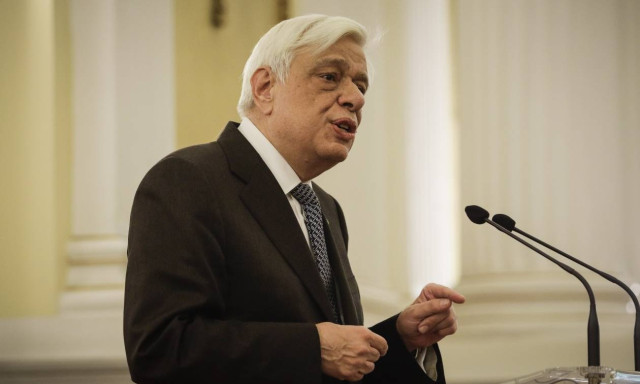
Asked about the prospects of cooperation between Greece, Cyprus and Egypt to delimit an EEZ that had both economic and geostrategic importance for the three countries, Pavlopoulos noted that the way this was done would serve as a general precedent for implementing the rules of international law in this area.
He noted that this was currently mainly governed by the UN Convention on the Law of the Sea signed in Montego Bay in 1982, rules that Cyprus, Greece and Egypt were abiding by in collaboration with each other, while "Turkey is moving in the opposite direction and sometimes, in fact, in a completely arbitrary and provocative way."
"We must all of us make it clear to Turkey - not just our three countries but the European Union and the United States generally - that it has an obligation to respect in the area of delimiting EEZs, international law and specifically the law of the sea," Pavlopoulos said.
The fact that Turkey had not signed the Montego Bay convention did not mean that it was not bound by it, the Greek president noted, citing rulings by the international court at The Hague that considered the convention binding for all, given that the great majority of countries had now signed it "making it a generally accepted rule of international law."
Referring to bilateral relations between Greece and Egypt, Pavlopoulos said his visit "confirms, in the most emphatic way, the excellent relations between Greece and Egypt," noting that these was apparent from several aspects of cooperation between the two countries, which was constantly expanding.
He especially noted Egypt's efforts against ISIS and terrorism, saying that the West and the EU had to acknowledge that Egypt had acted as an irreplaceable protection against terrorism under el-Sisi's presidency. He also highlighted Greece's role in the rapid progress of EU-Egypt relations and the fact that the EU now recognise the significant role that Egypt plays in the region.
"Peace and stability in the Middle East are a key concern for the EU, in addition to neighbouring countries, as the horrific terrorist crimes by ISIS have proved. But the EU was not, unfortunately, as present as it should have been when there was an undisputable need to take action to stop the war operations from spreading and to cut ISIS terrorism in the bud," Pavlopoulos said.
He underlined the need to work intensively toward the completion of the European foreign and security policy arm, before it was too late.