Leaders of Cyprus, Egypt and Greece issue Joint Declaration, condemning Turkey's illegal actions
The leaders of Cyprus, Egypt and Greece strongly condemned Turkey’s illegal drilling and seismic operations in Cyprus’ EEZ as well as Turkey’s actions in the fenced off area of Varosha in violation of relevant Security Council Resolutions, and called on Turkey to terminate its provocative actions and comply with UN Resolutions.
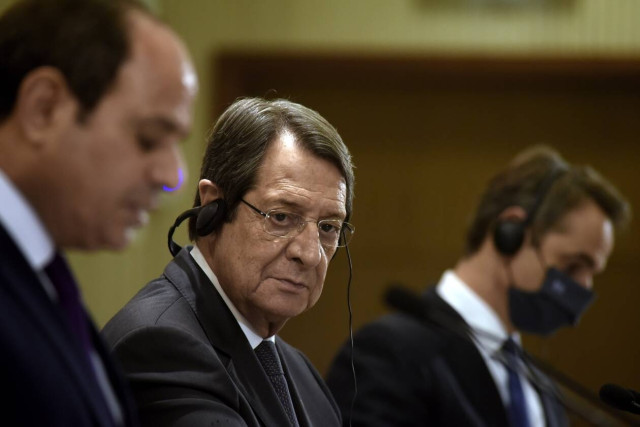
In their Joint Declaration after the Cyprus, Egypt, Greece Trilateral Summit in Nicosia on Wednesday, Republic of Cyprus President Nicos Anastasiades, Arab Republic of Egypt President Abdel Fattah El-Sisi, and Prime Minister of the Hellenic Republic Kyriakos Mitsotakis reiterated their " unwavering support to the efforts of the Government of the Republic of Cyprus to reach a comprehensive, just and viable solution to the Cyprus problem based on the relevant U.N. Security Council Resolutions and international law".
"We condemned Turkey’s actions in Varosha in violation of relevant Security Council Resolutions and called on Turkey to terminate its provocative actions, comply with UN Resolutions in particular 550 (1984) and 789 (1992) and to contribute constructively and in concrete terms for the resumption of structured and result oriented negotiations for a comprehensive and sustainable settlement of the Cyprus problem on the basis of the relevant UN Security Council Resolutions," they underlined.
They noted that "such a solution must be compatible with the Republic of Cyprus’ capacity as an EU member state and fully safeguard its independence, sovereignty, territorial integrity and security. To this end, the termination of the anachronistic security arrangements and the withdrawal of foreign forces remain a sine qua non for the Republic of Cyprus as a sovereign state. We stressed that the United Nations remain the only framework through which a settlement can be achieved".
In addition, they state that they expressed their grave concern over the recent escalation within the maritime zones in the eastern Mediterranean and the increased militarization of the area that threatens the wider stability, peace and security in the Mediterranean Sea.
"We strongly condemned Turkey’s illegal drilling and seismic operations in Cyprus’ EEZ/continental shelf, in marine areas already delimited in accordance with international law, including between the Republic of Cyprus and the Arab Republic of Egypt, by means of the 2003 EEZ Delimitation Agreement".
Furthermore, "we also condemned the continuous violations of Greek national airspace and territorial waters in the Aegean Sea and Turkey’s illegal activities in areas falling within Greece’s continental shelf, in contravention of international law. We stressed the importance for the respect of the sovereignty and the sovereign rights of each state in its maritime zones in accordance with international law, and as reflected in the UN Convention on the Law of Sea (UNCLOS) and called on Turkey to permanently abstain from such actions in the future, thus helping create conditions conducive to dialogue which cannot be conducted in an aggressive environment or under the threat of use of force".
The Joint Declaration adds that "we underlined that the delimitation of the Continental Shelf and Exclusive Economic Zone should be addressed through dialogue and negotiation in good faith, in full respect of international law. In this respect we call on Turkey to accept the invitation by Cyprus to engage into negotiations, in good faith and in full respect of international law, with the objective to reach an agreement for the maritime delimitation between their relevant coasts, or to submit the issue to the International Court of Justice. In the same vein we welcomed the signing and entry into force of the Agreement on the delimitation of EEZ between Greece and Egypt, a milestone agreement which has been concluded in full compliance with International Law as reflected in UNCLOS, as it contributes to stability and security in the East Mediterranean region".
They also discussed a broad range of issues and reiterated the importance of enhancing our efforts in promoting peace, stability, security and prosperity in the East Mediterranean.
In their Joint Declaration they state that they reviewed the latest stance of the ambitious and ongoing cooperation mechanism, which is considered as an important milestone in the relations between the three countries. Furthermore, they elaborated on progress achieved in sectoral cooperation, inter alia, in the fields of defense and security, energy, investments, tourism, diaspora, protection of the environment, protection of cultural heritage, research and innovation, and education.
They expressed their desire to continue strengthening their cooperation through a series of agreements on the exploration and transfer of natural gas, which further highlights the fact that the discovery of hydrocarbons reserves can serve as a catalyst for regional stability and prosperity.
In this regard, they warmly welcomed the signing of the statute of the East Mediterranean Gas Forum (EMGF) by all seven Founding Members, which establishes the EMGF as a regional organization, based in Cairo, open to all countries that share the same values and objectives of the EMGF and willingness to cooperate for the security of the whole region and the welfare of its peoples.
"Established on the fundamental principle that it fully respects the Members’ rights over their natural resources, in accordance with international law, the EMGF will support their efforts in unlocking the full gas resource potential in the region and to monetizing their reserves".
They also reaffirmed the importance of the establishment of the EuroAfrica project, as an electricity interconnector between the grids of Egypt, Cyprus and Greece, that promotes the trilateral cooperation and enhances the security of energy supply, not only of the countries involved but also of Europe, as it will create a highway for the transmission of significant amounts of electricity generated from gas from the Eastern Mediterranean fields but also from renewable energy sources.
"The EuroAfrica Electricity Interconnector constitutes an important component of the strategy to accelerate the development of the Eastern Mediterranean Energy Corridor as a new alternative source of energy supplies from the region to the European Continent and vice versa. In this regard we look forward to the swift signing by our respective ministers, of a memorandum of understanding which sets forth the framework of cooperation to enable the timely implementation of the project, reflecting our shared commitment towards this goal".
The three leaders reiterated their commitment to establish a Permanent Secretariat for the Trilateral Mechanism between Cyprus, Egypt and Greece, based in Nicosia, in a way that maintains the uniqueness of the relations between the three countries. To this end, they also agreed to proceed with the appointment of Country Representatives to the Secretariat at the earliest, with a view to enabling the Secretariat to start operating before the end of 2020.
Regarding Libya, they expressed their commitment to the unity, sovereignty and territorial integrity of the Libyan state, and rejected the detrimental intervention by Turkey in Libyan affairs, in violation of United Nations Security Council Resolutions 1970/2011 and 1973/2011 and 2441/2018.
"We also rejected Turkey’s export of arms and military equipment, as well as its sponsoring of the transfer of foreign terrorist fighters into Libya, in clear violation of UN Security Council Resolution 2396(2017)".
In addition, they reiterated that the Memorandum of Understanding on the Delimitation of the Maritime Jurisdiction Areas in the Mediterranean and the Memorandum of Understanding on Security and Military Cooperation signed in November 2019 between Turkey and Mr. Fayez El Saraj, "are respectively in contravention of international law and the UN arms embargo in Libya and that both undermine regional stability. We recalled that the Memorandum of Understanding on the delimitation of maritime jurisdictions in the Mediterranean Sea infringes upon the sovereign rights of third States, does not comply with the Law of the Sea and cannot produce any legal consequences".
The Joint Declaration adds that "encouraged by the positive results thus far and convinced by the strategic importance of the trilateral cooperation between our three countries, we expressed our firm determination to continue working closely on issues of mutual interests to the benefit of our peoples and of the peoples of the wider region".
(Cyprus News Agency)