March 25th : “Go, rebel Greece”
"Go, rebel Greece, stand up, hold your strength with the strong arms. Olympus was not rise in vain, Pindos and Thermopiles, your honor." says the poem of the great Russian poet Pushkin.
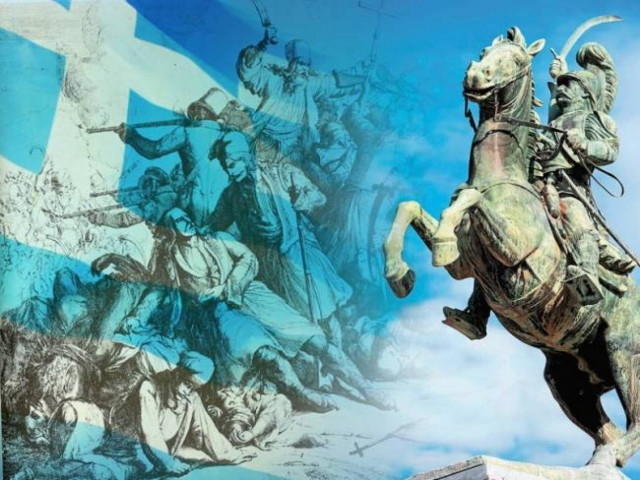
March 25: Day of faith and freedom. Since the beginning of the uprising seemed that the road will be filled with the blood of Greek fighters.
The amazing miracle of the 1821 assault was on the verge of insanity, but a "divine madness" as said Nikos Kazantzakis in a text of 1947.
Our ancestors for 400 years kept alive the hope of freedom from the Turks. And they chose the 25th March, the day of the Annunciation to shake off the yoke of the conqueror. There, in the secret schools and the Church were taught with the help of God to fight for their freedom.
THE OUTBREAK OF THE REVOLUTION
On March 1, departed from Constantinople to the Peloponnese, after effects of "Filikos" Xanthos, a ship loaded with notices of rebellion. With this ship arrived in Mani in late March the news of the insurrection in Moldavia and Wallachia. Some unrest of Christians in Constantinople related to the uprising, when the revolution broke out in Moria, gave rise to massacres. Fotakos says that the Greeks who were coming in Greece from Russia and Constantinople, were speculating as opening day of the revolution the March 25th.
Georgios Karaiskakis

Shortly after the uprising in the Romanian principalities, but not because of them, the Turks of Tripolis called the notables of Moria with the usual pretext of the joint annual meeting, but in order to hold them hostage. Most notables were hesitant and did not go. Those who went, were later executed, some with the outbreak of the revolution, others a few days before the fall of Tripoli and more died from hardships in prison.
In mid-March 1821 Papaflessas had completed cycle tour of the Peloponnese and was with Anagnostaras in Messinia, area for which prescribed officer of the Filiki Eteria (Society of Friends). Kolokotronis was also in the area of his responsibility, Mani. Odysseus Androutsos was hidden in Patras, ready to take action. Other members were in different places of their responsibility. Despite the doubts of elders, the climate in the Peloponnese was strongly revolutionary and a spark was missing for the big explosion.
The 25th March had been set as the day of commencement of the revolution by Alexander Ypsilanti in 1820. It had even chosen precisely because it is the day of the Annunciation. Although for various reasons the revolution had already begun to Moldovlachia and broke out earlier in various areas of the Peloponnese, in some areas began exactly the prescribed date with the sieges of castles, rebellion or rituals.
The first rebel camp was formed in Vervaina on March 25, 1821 by Anagnostis Kontakis with warriors from Agios Petros, Doliana, Tripoli, and by Vresthenis Theodoret and P. Varvitsioti. In that place gradually gathered chieftains and warriors from different places and organized the first supply unit ("tutorial" according to Fotakos).
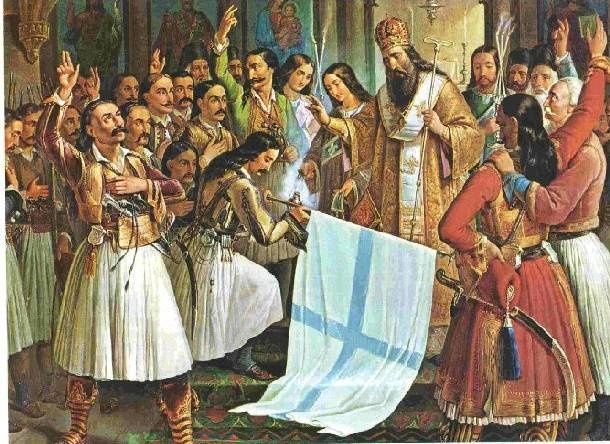
The scene of the ritual for declaration of revolution in Aghia Lavra, was legendary. This is mentioned by several contemporary sources while younger historians consider this unreal. Legend has become more prominent in the official Greek national narrative, correlating religion with the revolution and equating national and religious identity. German himself does not mention the scene from that day in his unfinished memoirs. From the writers of the Revolution only Kanellos Deliyiannis mentions this, while Michael Economou mentions that in all the provinces of the Peloponnese the flags with the Cross were raised on March 25.
"All glory, all grace, holy day dawns
and the Nation hails kneeling your memory.
And your breasts in flames calcined by the golden sun,
which walks proudly in heaven".