When Leonidas said: "Molon Labe!" (Come and get them!)
The Battle of Thermopylae is one of the most important battles in Greek and world history.
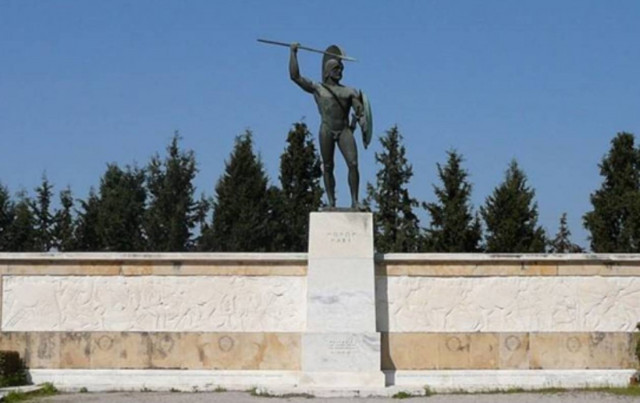
Mostly though, morally is a shining example of selflessness, sacrifice and obedience to the homeland. The battle showed the advantages of Spartan military training, of the best equipment and the intelligent use of soil formation.
Alongside, the message which was sent to the ends of the earth by Leonidas and his men remains strong and inter-temporal: Greeks do not capitulate and they do not bow to anyone. This is a message highly proper in the modern era in which our country tested under the inhuman demands of our lenders.
The Battle of Thermopylae took place in 480 BC (along with the Battle of Artemisium) between the Greeks and the Persians, during the second Persian invasion of Greece. The Persians were defeated at Marathon ten years earlier, so they prepared a second campaign which was led by Xerxes. The Athenian politician and general Themistocles persuaded the Greeks to close the straits of Thermopylae and Artemisium. The Persians, who, (according the ancient sources) had millions of men in the army and (according the modern sources) had hundred to three hundred thousand men, arrived at the Strait of Thermopylae in early September.
After four days of waiting, the Persians attacked, but the Greeks resisted for two days. On the third day, Ephialtes led the Persians behind the Greeks. When he learned this, Leonidas ordered the retreat of most Greeks - he remained on the battlefield with 300 Spartans, 400 Thespians, 400 Thebans and even a few Greeks. The Persians killed all who remained on the battlefield. The Greek fleet, after learning the news, decided to depart from the Artemision and retreat to Salamis, where he later achieved a significant victory. The Persians retreated completely after the battles of Plataea and Mycale.
The Persians arrived at Thermopylae in late August or early September. At that time, the Spartans were celebrating Karneia, while it was also the period of the Olympic Games - a conflict at that time was considered sacrilege. Despite this, the Trustees of Sparta felt that the emergency situation was serious enough to excuse sending troops led by Leonidas. Herodotus mentions the prophecy of the Delfi oracle: either Sparta would be lost or it will lose a king:
Leonidas believed he had to die in order to save Sparta, so he took only 300 Spartans, who had sons, with him. During the course, the Spartans were reinforced with 5,000 other men. Leonidas decided to line the Spartans in the center, where was the narrowest point of Thermopylae and the Phocians undertook to build a defensive wall. 1,000 Phocians were sent to defend Trahina since from there the Persians could encircle the Greeks. When the Persians arrived in the area, the Peloponnesians were saying that they had to go to the Isthmus of Corinth and defend themselves there. But the Phocians and Locrians convinced Leonidas to stay in Thermopylae.
Xerxes sent ambassadors to convince Leonidas to lay down its arms. The answer of Leonidas was "Molon labe" (Come and get them!). The battle was inevitable, but Xerxes wanted to wait four days, believing that the Greeks would scatter.
The Persians, after four days of waiting, attacked - first Xerxes sent Medes and Kissious that attacked frontally the Greeks. The Greeks were lined up in front of the wall, built by the Phocians and was the narrowest pass of Thermopylae.
Only Diodorus describes the tactics of the Greeks: Greek arrayed in dense formation and were superior in valor and the size of the shield - the wooden shields and small spears of the Persians were not effective in battle with the Greeks.
According to Herodotus, the Greeks killed many Medes, so Xerxes got up three times from his throne - Ctesias says that the first day killed only two to three Spartans. Xerxes later sent the Immortals, led by Hydarnes, but they also failed. The Spartans were pretended their withdrawal, the Persians swayed, and that is why many Persians were killed on the first day of the battle.
The next day, Xerxes repeated the attack since he considered that the Greeks because of their small number could not resist. The attack was not successful and Xerxes ordered retreat and withdrew embarrassed on his tent. In the afternoon, while Xerxes was thinking what to do, accepted the visit of Ephialtes, who suggested a path from which it could encircle the Greeks. The Ephialtes (nightmare) became the standard of the traitor in Greek and world history. Xerxes sent immediately the Hydarnes with the Immortals to encircle the Greeks - remains unknown how many. Herodotus writes that the Persians crossed the river Asopus and that from the left was the Trahina and from the right was mount Iti.
At dawn, the Phocians realized they were surrounded by the Persians and hastily grabbed their weapons. At first the Persians thought they had to face the Spartans, but the Phocians retreated to a nearby hill. Then, it followed a barrage of arrows, as the Persians did not want to delay further.
Furthermore, a watcher alerted the other Greeks that the Phocians had withdrawn. Most Greeks suggested retreat, but Leonidas decided to stay with the Spartans and the other Greeks, with or without order, were retreated.
Along with Leonidas were the 300 Spartans, 700 Thespians (led by Dimophelos) and 400 Thebans.
Xerxes made sacrifices and started the attack - the Greeks moved forward, in the widest point of Thermopylae. The Greeks fought at first with spears and later with their swords. During the battle killed the Avrokomis and Yperanthis, who were brothers of Xerxes, and later Leonidas was killed by the Persian arrows. Then began a fierce battle around the body of the Spartan king, in which the Greeks won. When the Immortals appeared, the Greeks, except the Thebans, retreated behind the wall - the Thebans surrendered and Xerxes marked them with the royal mark. For the rest of the Greeks, Herodotus writes:
In that space, those who still had swords and others the others that were fighting with arms and teeth, were killed by the barbarians, (who had destroyed the wall), with arrows.
Thermopylae gained huge reputation as inspired future generations with the example of the few and brave soldiers of Leonidas. As stated by Michel de Montaigne, "the subsequent victories of the Greeks and their glory cannot be compared with the glorious fall of Leonidas and his men." On the other hand,
Thermopylae exemplifies heroism of free men who are defending their homeland and their freedom - Hanson says that "freedom was the main idea of the Greeks and led to their resistance at Thermopylae, Salamis and Plataea". Regarding the military, Thermopylae showed the highest military training of the Spartans and the proper utilization of soil formation.
The battle of Thermopylae has inspired poems, songs, proverbs, films (including films «The 300 Spartans» and «300») and books (like 300 comics) with naval matters. Also, the heroism of the Spartans in the Persian wars caused a phenomenon known in the West as Lakonofilia. The Greek poet Constantine Cavafy wrote the poem Thermopylae in honor of the soldiers who took part in the battle:
Thermopylae
Honor to those who in the life they lead
define and guard a Thermopylae.
Never betraying what is right,
consistent and just in all they do,
but showing pity also, and compassion;
generous when they're rich, and when they're poor,
still generous in small ways,
still helping as much as they can;
always speaking the truth,
yet without hating those who lie.
And even more honor is due to them
when they foresee (as many do foresee)
that Ephialtes will turn up in the end,
that the Medes will break through after all.












.jpg)